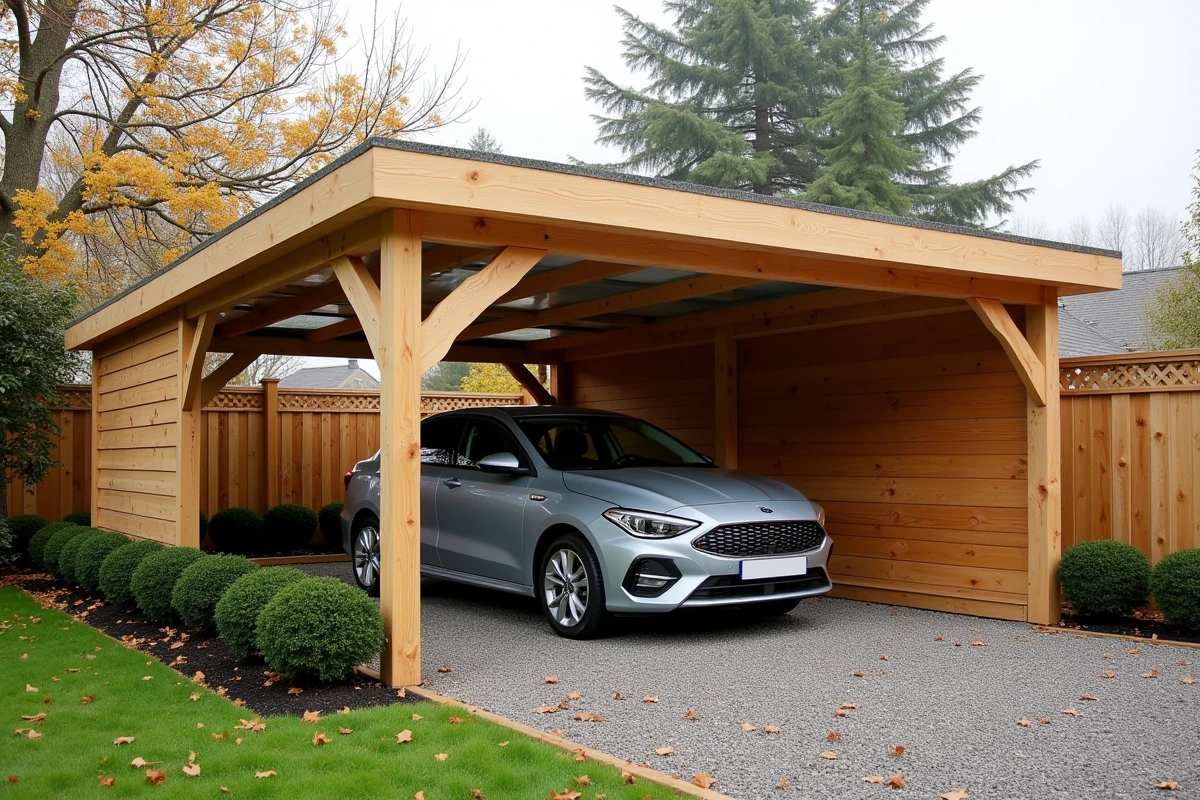
A neighbor who installs a pressure-treated pine carport on his property thinks he has made a good deal. Six months later, the posts are graying, the roof is sagging under the weight of the snow, and the town hall requests a prior declaration. A wooden carport remains a relevant solution to protect a vehicle without building a garage, but its actual cost often exceeds the price displayed for the kit.
Actual cost of a wooden carport: beyond the kit price
You look at the price tag, compare two or three stores, and place an order. The problem is that the kit price represents only part of the expense. The treatment of the wood, the roofing, the ground anchors, and any necessary land modifications are systematically added.
Raw or simply pressure-treated wood requires surface treatment in the weeks following installation. Without stain or saturator, the wood quickly turns gray and becomes vulnerable to fungi. Plan for treatment every two to three years minimum to keep the structure in good condition. This recurring maintenance transforms an “affordable” purchase into a continuous investment.
The roofing supplied with entry-level kits often consists of bitumen felt or a simple tarp. For real protection against hail or UV rays, one turns to steel sheets, bitumen tiles, or polycarbonate, which drives up the bill.
Returns vary by region and land exposure, but in areas with high rainfall, the original cover of a cheap kit generally lasts no more than a few seasons.
If you are looking for a wooden carport at Brico Dépôt, comparing the coverage options included in the kit with those to be added separately allows for a better assessment of the total budget.
Urban planning declaration for a wooden carport: common obstacles
The most underestimated constraint is not technical; it is administrative. A carport, even open on the sides, creates ground coverage. Below a certain surface threshold, a prior declaration of work is sufficient. Beyond that, a building permit is required.
- Below 5 m² of ground coverage, no formalities are required in most municipalities, but a carport of this size does not cover a vehicle.
- Between 5 m² and 20 m² (or 40 m² in areas covered by a local urban plan), a prior declaration is mandatory, with an instruction period of about a month.
- Beyond 20 m² (or 40 m² according to the local urban plan), a building permit is required, which extends the timelines and may necessitate the involvement of an architect.
Check the local urban plan before buying the kit to avoid unpleasant surprises. Some areas impose specific materials or colors, or even prohibit exposed wooden structures on the street facade. An undeclared carport may be subject to a report and a demolition order.
Wood species and assembly: two criteria that determine lifespan
Not all woods are suitable for permanent outdoor use. Pressure-treated pine class 3 or 4 is the most common in affordable kits. It resists moisture properly, provided the treatment is done thoroughly and not just on the surface.
Douglas fir and larch offer superior natural durability without chemical treatment. Their resin protects them against insects and fungi. The higher purchase cost is offset by reduced maintenance costs over time. A non-treated Douglas carport can last longer than a poorly maintained pressure-treated pine.
Mortise and tenon assembly or metal connectors
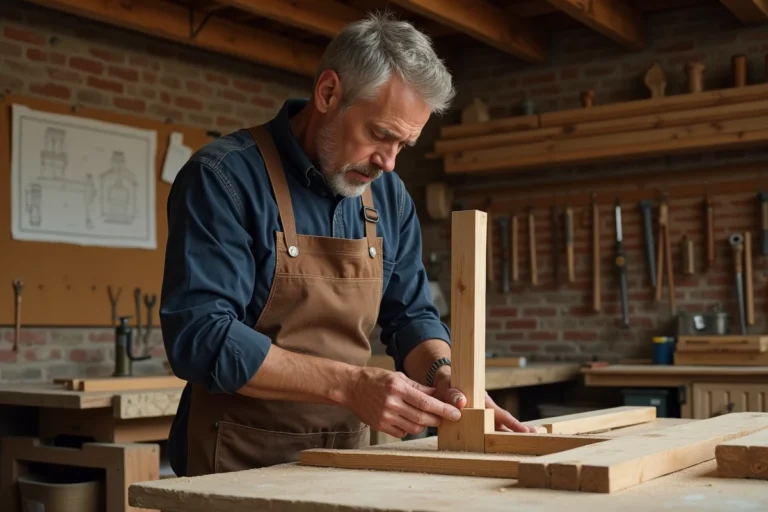
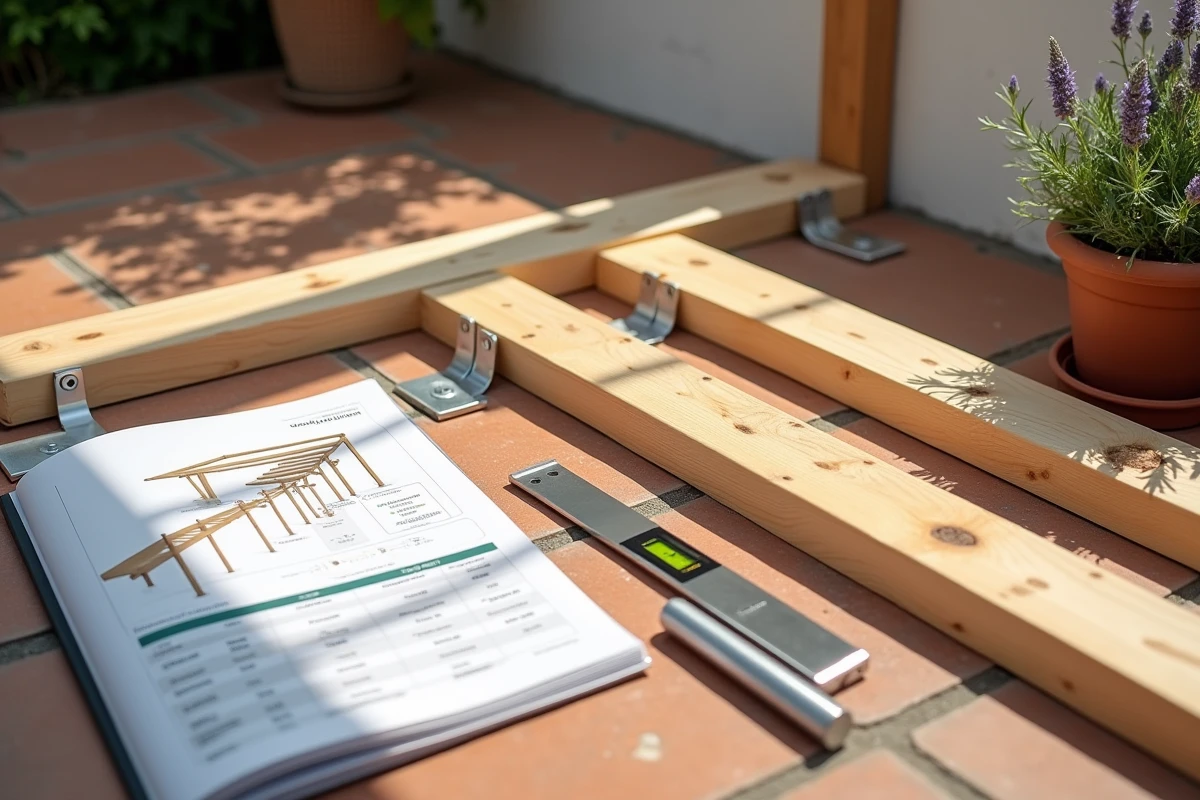
The traditional mortise and tenon assembly offers better structural rigidity and a more refined aesthetic. Metal connectors (brackets, shoes) simplify kit assembly but create weak points if the hardware is undersized.
Before ordering, check two things: the thickness of the posts (too thin posts bend under snow load) and the type of ground fixation. Anchor plates sealed in concrete footings ensure stability much better than simple stakes driven into the ground.
Attached or freestanding wooden carport: choose based on land configuration
An attached carport leans against an existing wall of the house. It costs less in materials since one side of the structure is already supported. In return, it requires a rigorous rainwater drainage system to avoid damaging the load-bearing wall. The junction between the carport roof and the facade must be carefully sealed.
The freestanding carport, independent of any construction, offers more placement freedom on the plot. It is better suited for properties where the house is far from the parking area or when one wants to protect a motorhome that exceeds the height of a standard attached carport.
Flat roof or sloped roof for a carport
The flat roof (with a slight slope for drainage) gives a contemporary look and limits the overall height, which can simplify compliance with the local urban plan. The sloped roof, whether single-pitched or double-pitched, drains water and snow better. In regions with harsh winters, the slope remains the safest choice to avoid overloading the structure.
The choice between steel sheets, polycarbonate, and tiles depends on the budget, desired aesthetics, and local regulations. Steel sheets offer a good compromise between lightness, strength, and price. Polycarbonate lets in light but heats up more in summer, which limits its usefulness for UV protection.
A well-sized wooden carport, placed on solid foundations and covered with a roof suitable for the region, protects a vehicle as effectively as a lightweight garage. The difference between a good deal and a source of problems rarely lies in the kit price. It is determined by the choice of wood species, the quality of the assembly, compliance with urban planning rules, and the regularity of maintenance.