
An overly open elbow, a shoulder slightly back, and an entire sports performance can tip over, sometimes without the athlete even noticing. Modern algorithms leave nothing to chance: to the millisecond, they capture the slightest variation in the angle of a joint. Thanks to online video and artificial intelligence, these discrepancies, often invisible to the naked eye, become levers to refine each gesture and aim higher.
Long reserved for research laboratories, certain biomechanical parameters are now making their way into remotely accessible tools. The precision of angular calculation has become a reliable benchmark for correcting technical gestures and accelerating progress, regardless of the athlete’s level.
Angles: an often underestimated key to understanding and improving sports performance
Behind every sports movement, every trajectory or rotation, lies a precise body geometry. The calculation of angles has become a cornerstone of gesture analysis, far beyond mere strength or speed. Mathematics applied to sports dissects this dynamic, whether discussing an explosive sprint or the elegance of a skater executing a spin. Performance is now measured by the finesse of control: angle of flexion, propulsion, reception—every detail matters.
In disciplines such as rhythmic gymnastics, figure skating, or jazz dance, this ongoing dialogue between angles, symmetries, and geometric formations is not limited to aesthetics. Adjusting an angle optimizes energy, limits the risk of injury, and increases execution speed. In running, everything relies on the balance between propulsion force, VO2 max, and anaerobic energy, all orchestrated by meticulous joint placement, the result of extensive observation and repetition.
Now, these analyses are no longer confined to university laboratories. Thanks to angle calculations on Sport en Ligne, every athlete, wherever they are in France or elsewhere, has access to a tool to quantify, compare, and correct their movements. Muscle strengthening data, frequency, volume, intensity, hypertrophy provide precise insights into progress in each discipline.
To better grasp this diversity of applications, here are some notable examples:
- In rhythmic gymnastics, the success of sequences depends on trajectories and angles.
- In figure skating, the symmetry of angles determines balance and rotations.
- In running, optimizing the push angle can transform final speed.
Today, sports performance relies on the ability to continuously adjust these parameters, thanks to the power of numerical analysis combined with field experience.
How video analysis and artificial intelligence are transforming the study of movements
The study of sports performances is undergoing a revolution with the advent of video analysis and artificial intelligence. Now, every movement, whether it’s a jump, acceleration, or rotation, is measured and scrutinized by high-definition cameras or motion sensors. At the mathematics laboratory in Versailles, Amandine Aftalion and her team from CNRS model running using optimal control equations, refining the understanding of effort, energy management, and propulsion strategies.
Motion capture is gaining ground: 3D cameras, force platforms, electromyography (EMG), specialized software… All trace the actual curve of the gesture, from speed profile to impact with the ground. The data, processed by artificial intelligence algorithms, offer tailored biomechanical analysis. This approach is revolutionizing physical preparation, rehabilitation, and technical adjustment. Coaches, here and elsewhere, receive precise reports on the initial take-off speed, speed curves, and acceleration profiles of their athletes.
Disciplines like padel have already embraced these technologies: by combining video analysis and statistics, it becomes possible to target areas for improvement, adapt training, and limit injuries. Medical-sports centers and online platforms integrate these tools to offer dynamic, regular, and shared evaluations. The Bocop software from Inria solves optimal control issues; Médimex enriches the range of physical tests with its measuring instruments. Now, performance analysis relies on objective data and scientific rigor, far removed from mere intuition or accumulated experience.
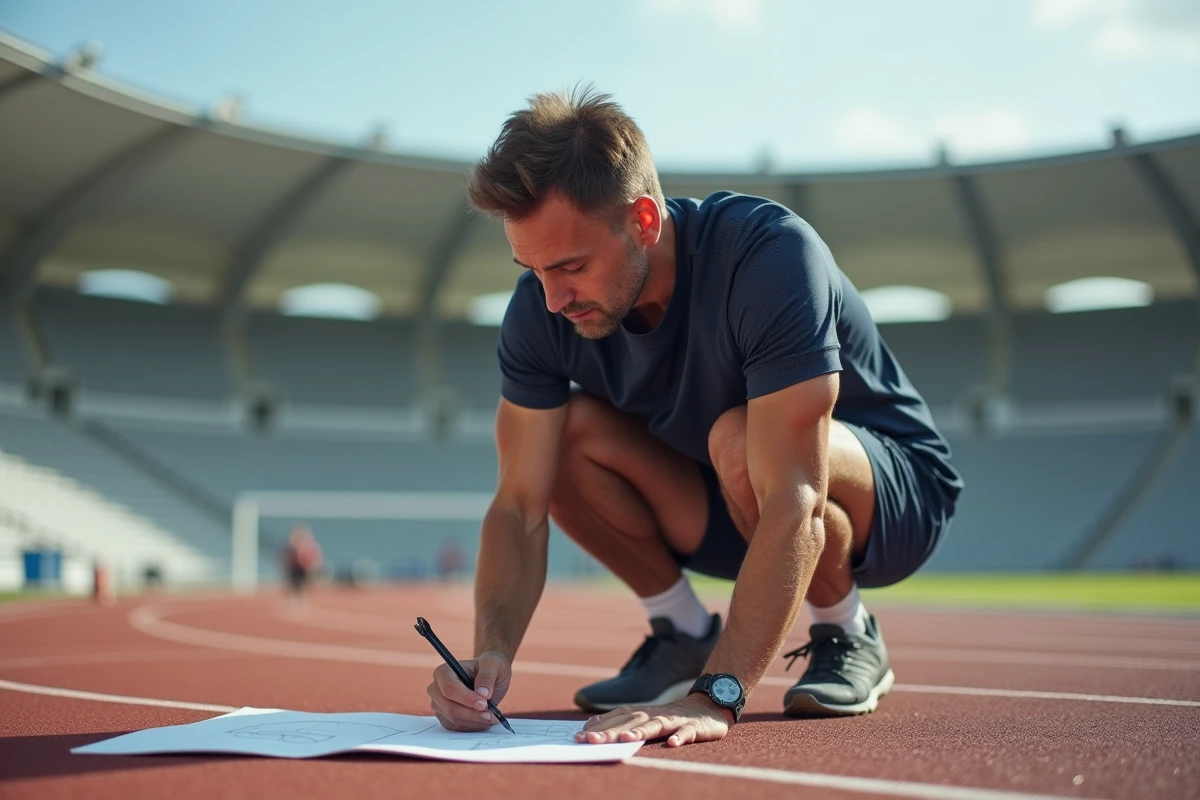
Practical tips for using analysis technologies and progressing in your discipline
To improve your sports performance remotely, a structured approach makes all the difference. First step: film your movements, even with a simple smartphone. Then analyze the key angles, knees, hips, shoulders. This initial observation allows you to objectify your movements and identify areas to work on. Disciplines like rhythmic gymnastics or figure skating illustrate this well: precision of placement, management of trajectories, pursuit of symmetries… it all starts there.
It is also relevant to rely on data from physical tests on a daily basis. To progress, closely monitor execution speed, power, frequency, and volume of your training. A linear coder, like that of Vitruve, for example, allows you to measure the speed of a jump or a muscle strengthening movement. By cross-referencing these measurements with video analyses, you gain a comprehensive and reasoned view of your evolution.
Finally, the dialogue between coach and athlete takes on a new dimension thanks to these tools. They facilitate exchange, allow for adaptation of mental preparation, and help prevent injuries. Motivation is fueled by concrete data, and the athlete’s psychology is integrated into the modeling of performance. By leveraging online resources, one gains access to tailored exercises, personalized plans, and immediate feedback. Progress becomes a continuous, precise effort, where every gesture counts and where technology supports humanity without ever replacing it.
Tomorrow, the boundary between laboratory and field will blur even further. Angles, once reserved for specialists, become the secret weapon for all those who want to push their limits, with every training session, with every movement.