
A seminar for 200 people in three weeks, a venue not yet confirmed, providers waiting for a brief: we’ve all experienced that moment when event planning shifts from “manageable” to “critical.” The difference between a smooth event and a chaotic one rarely lies in the budget. It lies in the sequence of decisions made in advance.
Event Backward Planning: Starting from the Final Date to Forget Nothing
Listing all tasks before placing them in a calendar seems logical. In practice, without a fixed starting point, milestones slip, and oversights accumulate as the schedule compresses.
The reverse approach works better: first, set the event date, then work backward week by week to position each milestone. This is the principle of reverse planning, which has become a standard in recent event management guides. We identify dependencies between tasks (the caterer cannot confirm the menu without knowing the venue, the venue cannot be booked without knowing the capacity), then estimate the actual duration of each step before building a chronological calendar.
To fully understand the key steps in event planning, one must think in terms of validation milestones rather than a task list. A milestone is a dated deliverable: “provider brief sent at D-45,” “room plan validated at D-21,” “final security check at D-3.”
A digital management tool (shared spreadsheet, project management software) is no longer a luxury; it is the foundation. Without shared visibility on progress, each team member works with their own version of the schedule, and discrepancies accumulate.

Event Budget: The Items That Really Go Overboard
We often talk about “setting a budget” as if it were a formality. In practice, the budget is built item by item, not as a global envelope. A starting envelope without detailed breakdown is a guarantee of discovering at D-10 that we forgot sound equipment or additional furniture.
The items that often go over budget are not the ones we monitor. Venue rental and catering are generally well managed because they represent the most visible amounts. The overruns come from elsewhere:
- Last-minute technical costs: additional wiring, video adapters, electrical extensions, emergency signage
- Changes to the room plan after validation, leading to additional furniture and logistics costs
- Extras related to participants (unanticipated dietary requirements, additional shuttles, replacement badges)
A safety margin on these “invisible” items protects better than a global margin spread across everything. Feedback varies on this point, but dedicating a specific budget line for technical contingencies avoids cutting back on the quality of main services.
Personalizing the Participant Experience: What Makes the Difference on the Day
Well-oiled logistics are a necessary condition, but not sufficient. An event where everything works but no one remembers anything has only achieved half of its goal.
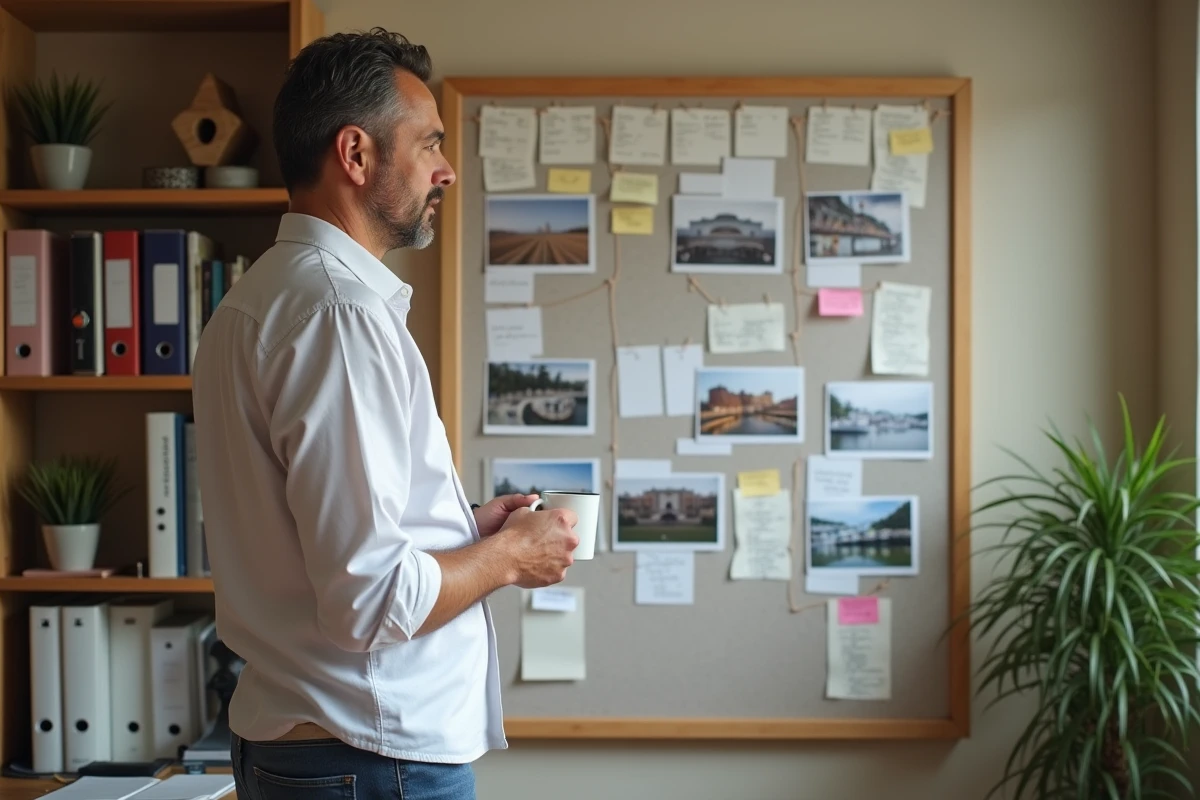
The experience is crafted in advance, not improvised on the day. Recent recommendations emphasize concrete elements: a shared visual mood board with providers to ensure a consistent atmosphere, playlists tailored to different times of the event (welcome, breaks, end of the day), and areas of conviviality distinct from workspaces.
This level of detail changes participants’ perceptions without necessarily inflating the budget. A welcome area with thoughtful lighting and well-designed signage costs barely more than a bare hall with a generic banner.
Interactivity and Visual Supports
Passive formats (top-down presentations, long speeches) tire an audience that expects interaction. Planning participatory moments, even short ones, alters the day’s dynamics. A 20-minute workshop between two conferences, a collaborative post-it wall, or a live poll on screen is enough to maintain attention and create engagement.
Post-Event Loop: Measure to Adjust the Next One
We pack up the materials, thank the providers, and move on. This classic sequence loses the most lasting value of an event: structured feedback.
The “prepare, measure, adjust” loop transforms each event into a lever for improvement for the next one. Collecting feedback from participants (questionnaire sent within 48 hours, not two weeks later) and debriefing with the organizing team on friction points allows us to capitalize on what worked and correct what went wrong.
The elements to document are not just qualitative:
- Discrepancies between the projected budget and the actual budget, item by item
- Deadlines met or exceeded on the backward planning, with identification of causes
- Actual participation rate compared to registrations, to refine future sizing
- Provider feedback on the quality of the brief and coordination on the day
This document becomes the working basis for the next event project. Without it, we start from scratch each time, with the same approximations and surprises.
A well-organized event does not rely on a natural talent for coordination. It relies on a reproducible method, clear milestones, and the ability to leverage each edition to refine the next one.