
Size L does not mean the same thing from one brand to another, nor from one country to another. The differences between a French L, an American L, and an Asian L can reach several centimeters in chest or waist measurements. This ambiguity is exacerbated by vanity sizing, which leads some brands to lower their size charts to flatter their customers.
Understanding what this size L really encompasses requires comparing concrete data, brand by brand and country by country.
Women’s and men’s size L: the differences between French, European, and American systems
Size conversion charts provide a standardized view, but the numbers vary according to the references. Here is a summary of the most common equivalences for size L.
| System | Women’s size L | Men’s size L |
|---|---|---|
| France (numbered size) | 40/42 | 40/42 |
| Numbered size (T) | T3 | T3 |
| Women’s chest measurement (cm) | 92-101 | – |
| Women’s waist measurement (cm) | 78-88 | – |
| Men’s chest measurement (cm) | – | 98-106 |
| Men’s waist measurement (cm) | – | 87-97 |
| US (indicative equivalence) | M/L depending on the brand | L |
The “Chest measurement” column already reveals a first trap: the range covered by a women’s L goes from 92 to 101 cm, which is almost ten centimeters of variation. For men, the difference is comparable. A person whose chest measurement is at the lower end of the range will wear a fitted L, while another at the upper end will have a garment tight at the seams.
To find out what size L corresponds to on Fashion Pulse, one must cross-reference these measurements with the specific size chart of each brand, as the correspondences above remain averages.

Vanity sizing and sportswear size charts: why an L no longer equals an L
The phenomenon of vanity sizing has blurred the lines for several years. The principle is simple: a brand discreetly lowers the measurements associated with each size so that customers feel like they are wearing a smaller size. An L sold today in certain women’s ready-to-wear brands may correspond to the measurements of an M from a few years ago.
This shift is not uniform. It affects women’s ready-to-wear more than men’s clothing, and more fast fashion than luxury or workwear brands.
The case of sportswear and outdoor clothing
Brands like Nike, Adidas, or Patagonia have revised their size L charts to accommodate more athletic body types. In practical terms, this translates to a broader shoulder and chest fit without an increase in the length of the garment. A sportswear L can therefore fit very differently from a dress shirt L, even with identical measurements.
This discrepancy poses a concrete problem when shopping online: ordering an L from a sports brand and an L from a traditional shirt maker results in two incompatible cuts. The only solution is to compare actual centimeters, not the letter on the label.
Measurements to take before choosing your size L
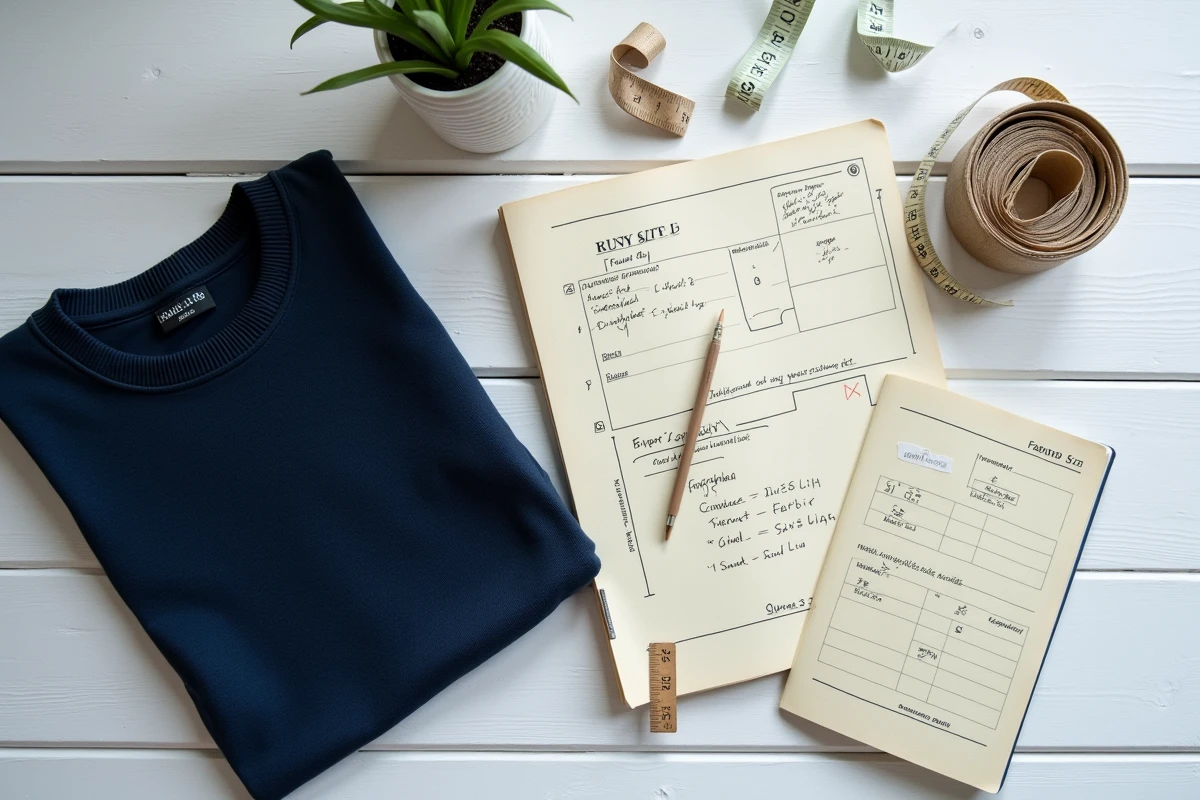
Three measurements are enough to determine if an L is suitable. They should be taken with a measuring tape, directly on the body, standing and relaxed.
- Chest measurement: the tape goes under the armpits, horizontally, at the fullest point of the chest. For women, measuring with a non-padded bra gives a more reliable result for everyday wear.
- Waist measurement: measure at the narrowest point of the torso, usually above the navel. Do not suck in your stomach or puff out: the measurement should reflect a natural posture.
- Hip measurement (or pelvis): the tape goes around the widest point of the hips. This measurement determines the size L for pants, skirts, and dresses.
The most reliable measurement is one taken by someone else, as the positioning of the tape in the back remains approximate when measuring alone. A difference of two centimeters is enough to shift from an L to an M or an XL depending on the brand.
Online recommendation tools: beyond the equivalence chart
Static charts show their limits as soon as you compare multiple brands. Platforms like Zalando have implemented personalized recommendation tools that cross-reference the provided measurements, purchase history, and feedback from other customers to indicate if a L from a given brand will fit larger or smaller than your usual L.
This type of tool changes the logic of choice. Instead of consulting a size guide, the buyer receives a recommendation tailored to the actual cut of the garment. The massive returns of online orders (related to size errors) have pushed these platforms to invest in the accuracy of these algorithms.
Limitations of these tools
Reliability depends on the volume of available data. For a recent item or a small brand, customer feedback is often too limited for the recommendation to be relevant. In this case, returning to raw measurements and comparing them to the manufacturer’s size guide remains the safest method.
The chest measurement, waist measurement, and hip measurement remain the three data points that any size chart uses. Knowing your measurements to the nearest centimeter makes any chart usable, regardless of the country or brand. The L on the label is just a starting point, not a guarantee of fit.