
The choice of a tire is not just a matter of size or price. Since the implementation of European regulation 2020/740, the labeling of car tires has been revamped with new criteria (noise, wet grip, QR code, snow and ice pictograms). This evolution changes the framework for motorists as well as motorcyclists, who must deal with constraints that can vary significantly depending on their vehicle and usage.
Driving aids and tires: an underestimated technical dependency
Recent driving assistance systems (automated emergency braking, lane keeping, adaptive cruise control) rely on a level of grip and precision that older generations of tires did not have to guarantee. Mercedes-Benz and Volvo, in their technical bulletins for 2023-2024, specify that non-approved tires can disrupt the functioning of these systems and increase stopping distances.
This point directly concerns recent vehicles equipped as standard with ADAS. Fitting tires of a different size or load index than the manufacturer’s recommendation does not only pose a wear issue: it can skew the calculations of the ESP or autonomous braking. On https://www.auto-moto-pneu.net/, product sheets associate tire references with manufacturer specifications, making compatibility verification easier.
For motorcycles, the question arises differently. Electronic aids (anti-skid, cornering ABS) have become widespread on high-end sports and touring models. Field reports vary on this point: some fitters report unexpected ABS activations with non-recommended sport tires, without manufacturers publishing comprehensive data on this subject.

European tire labeling: what the QR code changes for selection
Regulation (EU) 2020/740, applied since May 2021, introduced more detailed labeling. The label now includes a QR code linking to the EPREL database, where the verified performance of the tire is listed.
Three criteria are rated on the label:
- Energy efficiency (rolling resistance), rated from A to E, which affects fuel consumption and the range of electric vehicles.
- Wet grip, rated from A to E, which remains the most discriminating safety criterion between two tires of the same size.
- External rolling noise, expressed in decibels and accompanied by a pictogram, with thresholds that the European Commission is considering tightening.
Two additional pictograms allow for the identification of tires suitable for snow (3PMSF marking, the snowflake in the mountain) and ice (ice grip). The 3PMSF marking is required by the mountain law to circulate in certain areas during the winter period.
The Commission is working to integrate the environmental footprint into labeling, particularly tire abrasion and emitted microparticles. This aspect is not yet in effect, but it could significantly alter the ranking of some cheap soft rubber tires.
Car and motorcycle tire pressure: the most neglected parameter
Pressure is the maintenance factor that has the most impact on longevity, safety, and consumption. An under-inflated tire wears unevenly on the shoulders, heats up more, and increases rolling resistance.
The recommended pressure varies according to the vehicle load, not just according to the tire model. The label affixed to the door frame or fuel flap indicates the values to be respected under normal load and full load. On motorcycles, pressure is checked when cold, before riding, and the tolerated deviations are narrower than on a car.
Frequency and method of checking
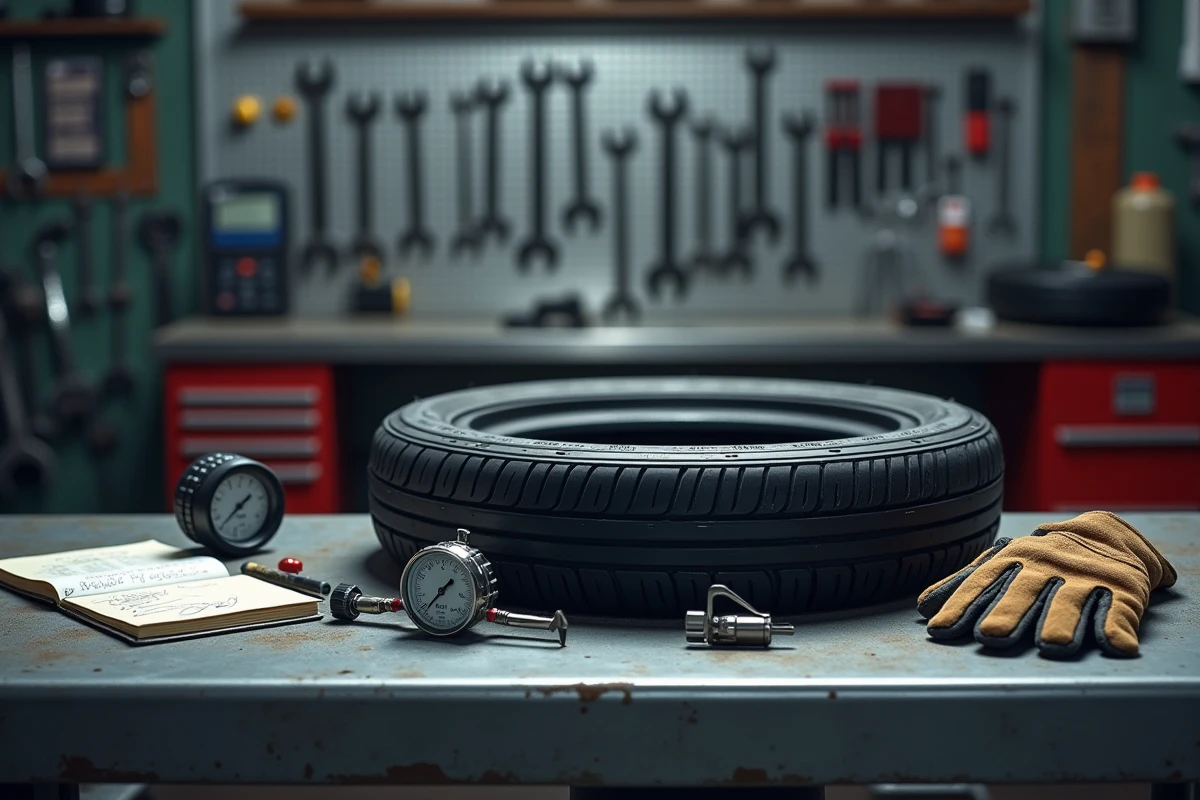
A monthly check is sufficient for daily car use. For motorcycles, a check before each extended ride is preferable, as the contact patch on the ground is much smaller. Portable digital gauges provide a more reliable reading than gas station pumps, whose calibration is not always verified.
Tire wear for motorcycles and cars: indicators and regulatory limits
The minimum legal tread depth is set at 1.6 mm for cars. On wet roads, grip decreases significantly well before reaching this threshold. Several manufacturers recommend replacing tires at 3 mm for cars and 2 mm for motorcycles, but these recommendations remain advice, not legal obligations.
Wear indicators (small bars molded into the main grooves) allow for a quick visual check. On motorcycle tires, wear is rarely uniform: a sport rear tire wears faster in the center on the highway, and on the sides during dynamic riding on winding roads.
When rotation makes sense
Rotating tires is common in cars to equalize wear between the front axle (often more stressed on a front-wheel drive) and the rear. In motorcycles, this practice does not exist: front and rear tires have different profiles, sizes, and functions.
Storing seasonal tires also deserves attention. A tire stored away from light, at a stable temperature, and in an upright position retains its properties longer than a tire left stacked flat in a garage exposed to temperature fluctuations.
Choosing a tire suitable for one’s vehicle, actual usage, and the season remains fundamental. European labeling facilitates comparison, but it does not replace regular checks of pressure and wear, two simple actions that condition both safety and the lifespan of the tire.